A single chamber system can clean far more than loose metal parts, but the result depends on the soil, part geometry, chemistry, bath control, and separation between dirty and final-clean stages. By matching components and contaminants to a realistic process sequence, you can decide which parts belong in one chamber, which require separate stages, and what evidence to demand before approving equipment.
Key takeaways
- Match frequency, chemistry, temperature, and time to the contaminant and part geometry.
- Use separate wash, rinse, filtration, drying, and preservation steps in one chamber.
- Inspect blind holes, threads, and narrow passages rather than judging surface appearance alone.
- Specify a cleaning trial with test soils, acceptance limits, and documented results.
Match the component and contaminant before choosing a cycle
A single chamber ultrasonic cleaner works best when you match the part, soil, chemistry, and cycle instead of treating every load as an oil-removal job. These industrial ultrasonic cleaning applications cover parts with exposed surfaces, blind holes, threads, narrow passages, and complex assemblies.
| Part | Common contamination | Suitable cleaning focus |
|---|---|---|
| Machined steel components | Cutting oil, coolant residue, chips, metal fines, rust-preventive oil | Alkaline or neutral wash, filtration, rinsing |
| Aluminum housings | Coolant residue, grease, particulate, coating-preparation residue | Aluminum-compatible chemistry and controlled temperature |
| Brass parts | Polishing compound, flux residue, tarnish, particulate | Chemistry that limits staining and residue |
| Bearings | Grease, oil, metal fines, particulate | Cleaning only when seals, lubricant requirements, and re-lubrication are defined |
| Molds | Wax, polishing compound, carbon residue, release residue | Longer dwell with chemistry suited to the mold material |
| Filters | Oil, chips, metal fines, particulate | Ultrasonic wash plus filtration and thorough rinsing |
| Nozzles | Carbon residue, coolant, flux, blocked particulate | Cavitation through small passages with correct orientation |
| Dies and assemblies | Cutting oil, wax, polishing compound, coating-preparation residue | Staged washing, drainage, and targeted rinsing |
Chemistry decides whether a soil dissolves, emulsifies, saponifies, or only detaches for removal. Ultrasonic energy assists heavy carbon, thick rust, baked-on scale, and bonded oxides, but it does not replace descaling chemistry, extended dwell time, or abrasive removal.
Oil skimming removes free-floating tramp oil from the bath, not dissolved or strongly emulsified oil held on the component. Replace or treat the bath when oil loading defeats cleaning.
What multi-process means inside one chamber
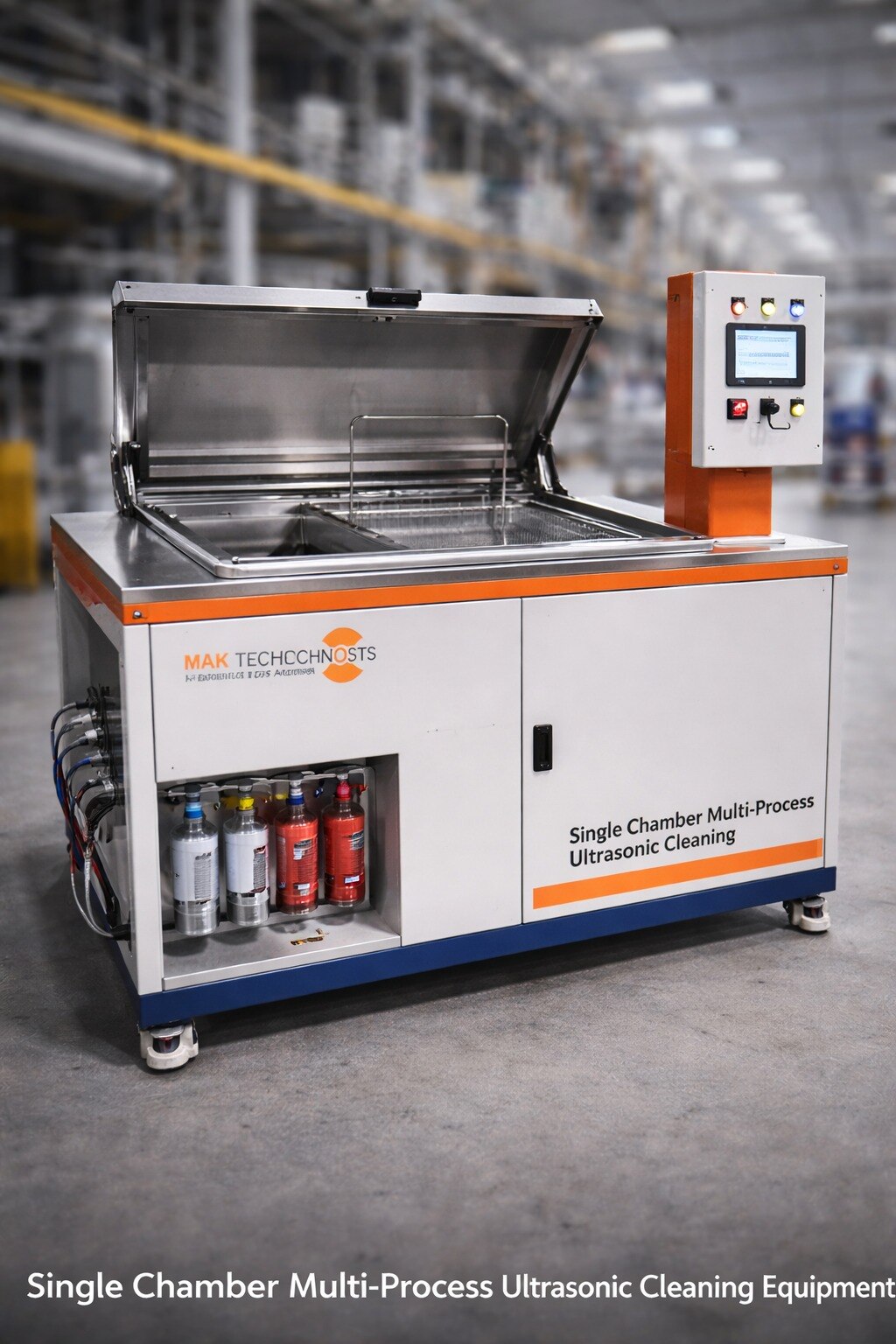
A recipe in multi process ultrasonic cleaning equipment moves the load through several operations without transferring it between tanks. The phrase single chamber multi process for equipment applications describes a timed sequence, not simultaneous cleaning.
1. Load a controlled basket with parts spaced for fluid access and orient cavities for drainage.
2. Run a prewash, ultrasonic wash, and drain period. Drainage removes dirty solution before an immersion or spray rinse.
3. Complete a hot rinse, passivation, or another chemical treatment, then allow the bath to separate free oil and pass suspended solids through filtration.
4. Finish with hot-air or vacuum drying. Bath temperature, detergent concentration, pH or conductivity, oil loading, filter condition, and recipe timing determine whether carryover recontaminates the parts.
One chamber is sufficient for compatible parts, controlled batch sizes, and soils that separate through time, rinsing, and drainage. Dedicated chambers are necessary beside a critical final rinse, for incompatible alkaline and acidic chemistries, solvent and aqueous processes, heavy oil loads, or a zero-residue finish.
Do not put ferrous and non-ferrous parts into one bath without qualified chemistry and a contamination-control plan. Shared alkaline solution can carry metal fines, dissolved soils, or reactive residues from one material to another; copper, aluminum, zinc, or magnesium can also demand different corrosion controls.
Treat these as design boundaries:
- Keep dirty washing separate from the final-clean stage when residue limits are strict.
- Confirm chemical compatibility before combining materials or treatments.
- Specify oil separation, filtration, drainage time, and carryover limits in the recipe.
How frequency, chemistry, and part geometry change the result
Cavitation reaches soil only when frequency, power density, chemistry, temperature, time, and liquid access match the part. Lower frequencies make larger, more energetic bubbles for robust parts and heavy soils; higher frequencies suit fine features and surfaces vulnerable to cosmetic damage. Excessive power or exposure can mark soft metals and finishes.
Set the bath temperature, detergent concentration, and pH within the chemistry supplier’s tested range. Agitation improves circulation, while filtration removes suspended particles; neither fixes excessive oil loading. Replace the bath when oil, soil, or depleted detergent causes redeposition.
Use this checklist for industrial ultrasonic cleaning applications:
- Qualify aluminum, zinc, magnesium, copper, plated or anodized surfaces, polished finishes, elastomers, plastics, coatings, and bonded parts against staining, swelling, delamination, or loss of adhesion.
- Treat blind holes, threads, and narrow passages only after confirming fill, drainage, and cavitation access.
- Reject shielded cavities, trapped air pockets, nested components, tightly packed baskets, and blocked surfaces unless qualified rotation, tilting, drainage, or fixturing exposes them.
- Space parts so liquid circulates around every surface; a nominal tank specification does not prove production capacity.
- Run production-sample trials on the densest representative load, especially soft metals and delicate finishes, rather than relying on the specification of a single chamber ultrasonic cleaner.
Temperature, alkaline strength, and time that clean steel can stain aluminum, attack zinc or magnesium, dull polish, or damage elastomers and plastics. Confirm the recipe on the actual finish before release.
Run the batch, control the bath, and prove cleanliness
A controlled batch moves from a spaced basket to documented inspection; each checkpoint prevents recontamination or an unprovable result.
1. Load parts with gaps for fluid access. Verify orientation, blind-hole drainage, and cavity escape paths; trapped air leaves surfaces dirty.
2. Check bath temperature, detergent concentration, pH or conductivity, oil loading, particle loading, and filter condition before starting. Filtration removes suspended solids but does not restore spent chemistry.
3. Run the qualified wash in the multi process ultrasonic cleaning equipment, using the approved frequency, power, time, and chemistry.
4. Allow adequate drainage so dirty solution does not dilute the next stage or return to cleaned surfaces.
5. Complete every specified immersion or spray rinse, hot rinse, passivation, or other treatment. Oil separation removes free-floating tramp oil, not dissolved oil or strongly emulsified oil.
6. Dry at the qualified temperature, then unload and inspect without touching critical surfaces.
7. Record the batch and inspection result against an acceptance test defining the contaminant, material and finish, load orientation, cycle settings, allowable residue or particle level, drying requirement, and repeatable inspection method.
For solvent service, specify equipment classification, vapor containment, ventilation, ignition-source control, and worker-exposure controls; an open tank is not automatically suitable. Aqueous systems also produce wastewater containing detergent, oil, metal fines, and process chemicals, so define segregation, treatment, and discharge routes.
ASTM G131 is a process-development reference, not a guarantee of production cleanliness. Validate the actual part and cycle.
Specify the trial instead of buying on chamber volume
A 1,000-litre chamber does not deliver 1,000 litres of usable cleaning capacity. Dense baskets, nested parts and blocked surfaces restrict circulation, leaving blind holes dirty while empty space inflates the advertised volume.
Request a trial report or technical datasheet that records:
- Verified ultrasonic frequency and power density
- Usable basket dimensions, load mass and part orientation
- Temperature range, cycle times, and detergent and solvent compatibility
- Filtration capacity, oil-separation method, rinse arrangement and drying method
- Measured cleanliness results, allowable residue or particle level, and the inspection method
| Evidence | What to compare | Why it matters |
|---|---|---|
| Nominal capacity | Chamber volume versus usable basket volume | Blocked circulation reduces the effective load |
| Process capability | Single chamber multi process for equipment applications, with wash, rinse, treatment and drying stages | Sequential operations do not clean simultaneously |
| Trial load | Dirtiest representative parts, blind holes and densest production basket | A clean demonstration part hides access and drainage failures |
| Production fit | Part, soil, finish, throughput, wastewater route and inspection method | A successful test must represent your actual process |
Require documented tests at production load, not a polished sample. Confirm whether the chemistry suits ferrous and non-ferrous parts without carryover or finish damage.
For buyers comparing ultrasonic cleaning equipment in Pune, Mak Technosys is worth discussing only against those documented conditions. The decision is whether the trial matches your requirement, not whether the machine has multiple processes.
Related product
 | Ultrasonic Cleaning Equipment Single Chamber Multi-Process Ultrasonic Cleaning Equipment Single Chamber Multi-Process Ultrasonic Cleaning Equipment in Pune In today’s precision-driven manufacturing environment, maintaining component... View product → |
Frequently asked questions
What does multi-process mean in a single chamber ultrasonic cleaner?
It means one chamber performs programmed stages such as ultrasonic washing, rinsing, filtration, drying, and preservation without transferring the parts between separate tanks.
How do frequency, chemistry, and part geometry affect ultrasonic cleaning?
Lower frequencies deliver stronger cavitation for heavy soils, while higher frequencies suit delicate or finely finished parts. Chemistry, temperature, exposure time, blind holes, threads, and narrow passages also determine the result.
How can you prove that a batch is clean?
Define an acceptance limit, control bath concentration and temperature, record the cycle, and verify representative parts with methods such as visual inspection, gravimetric residue testing, water-break testing, or particle analysis.
What should you specify before buying single-chamber multi-process ultrasonic equipment?
Specify the component material, dimensions, load weight, contaminant, cleanliness limit, cycle stages, chemistry, drying method, throughput, and trial acceptance criteria instead of choosing by chamber volume alone.