A bearing washer can keep running while its cleaning capability declines through blocked nozzles, contaminated baths, scale, worn seals or weak drying. You will be able to build a maintenance schedule, diagnose bearing washer maintenance problems, verify cleanliness, choose the right cleaning method and prepare useful service records for a Pune production line.
Key takeaways
- Record temperature, pressure, conveyor speed and detergent concentration at fixed intervals.
- Check filters, spray nozzles, seals, pumps, heaters and dryers during scheduled inspections.
- Use pressure, temperature and differential-pressure trends to isolate cleaning failures.
- Document utilities, spare parts and machine readings before booking specialist service in Pune.
Build a maintenance schedule that protects cleaning performance
How to maintain bearing cleaning equipment on production lines in Pune starts with a schedule tied to process readings, not downtime alone. Record tank temperature, wash and rinse pressure, conveyor speed, detergent concentration, filter differential pressure and dryer performance at a fixed frequency.
- Daily: Check leaks, abnormal pump noise, nozzle spray pattern, bath level, temperature, detergent concentration, conveyor movement, air-knife flow, drain paths and control-panel alarms. Remove sludge and visible debris without entering guarded zones.
- Weekly: Inspect and clean nozzles, filters, brushes, seals and exhaust points. Drain moisture from compressed-air lines, check air quality, and measure water and air pressure at the machine. Log changes instead of relying on operator impressions.
- Monthly: Test spray coverage across a bearing, inspect pump output, heater operation, interlocks, transducers, dryer filters and electrical connections. Check hard-water scale on tanks, heaters and nozzles; compare process readings with the acceptance range.
- During a planned shutdown: Apply lockout/tagout to electrical, pneumatic, hydraulic, thermal and chemical energy before entering tanks or guards. Descale tanks and heaters, inspect conveyor bearings and seals, replace damaged hoses and filters, and service vapor-degreasing condensers, seals, water separators and freeboard zones.
A bright bearing is not proof of cleanliness. Define limits for particles, residual oil and rinse water, then verify them through documented extraction with gravimetric, microscopic or particle-counting analysis. After maintenance, run a recorded test load; confirm readings, cleanliness and dryness before releasing the line.
Inspect every component, not only the conveyor and pump
Treat every component as part of the cleaning process: a clean conveyor cannot compensate for a blocked nozzle, scaled heater or weak dryer. Isolate electrical, pneumatic, hydraulic, thermal and chemical energy before entering a tank or guarded zone; guards and interlocks do not replace lockout/tagout.
- Nozzles: remove or inspect them, check spray patterns and alignment, and confirm bearing surfaces are not shielded by the conveyor.
- Pumps: record pressure and flow; investigate rising motor load, leakage or declining output.
- Filters: read differential pressure, inspect the housing seal, and verify the element’s micron rating, flow capacity and chemical compatibility.
- Tanks and heaters: remove sludge and scale; use water analysis and compatible descaling chemistry, because aggressive acid can damage stainless steel, seals, heater sheaths and ultrasonic assemblies.
- Conveyor, seals and brushes: check speed, tracking, leaks, hardening, wear and contact with bearing surfaces.
- Ultrasonic transducers: inspect for loose connections, abnormal heating and damaged bonding.
- Condensers, dryers and exhaust: clean heat-transfer surfaces, confirm airflow and drain moisture; inadequate exhaust leaves vapour and heat in the work area.
- Controls: test temperature, pressure, level, speed, alarms, guards and interlocks.
Record these readings at a fixed frequency for conveyorized bearing cleaning maintenance: tank temperature, wash and rinse pressure, conveyor speed, detergent concentration, filter differential pressure and dryer performance. Compare trends, not just downtime; gradual nozzle blockage, bath contamination or declining pump output can spoil bearings before an alarm appears.
Use process readings to diagnose cleaning and drying failures
Record tank temperature, wash and rinse pressure, conveyor speed, detergent concentration, filter differential pressure and dryer performance at the same interval each shift. Trends expose bearing washer maintenance problems before parts fail a cleanliness check.
1. A dirty bath shows rising oil, fines or turbidity while detergent concentration remains within its target range. Confirm with a sample, filter differential pressure and cleaning-verification results; do not correct contamination by adding detergent.
2. Incorrect detergent concentration appears as a titration or refractometer reading outside the supplier’s specified range. Low concentration leaves soil behind; excessive concentration can increase residue, foaming and rinse demand.
3. Weak spray pressure affects all spray zones. Compare pump discharge pressure and flow with the baseline, then inspect for a clogged filter, bypassing relief valve, low tank level or pump wear.
4. Worn or damaged nozzles create uneven coverage or a broadened, weak spray pattern at one location. Remove or inspect nozzles, compare flow between matching positions and check that the conveyor does not shield bearing surfaces.
5. Poor contact time follows a conveyor-speed increase, overloaded basket or incorrect bearing orientation. Reduce speed or restore defined spacing and orientation, then verify cleanliness rather than compensating with higher pressure.
6. Inadequate drying leaves moisture when dryer temperature, airflow or exhaust differs from the established baseline. Check fan performance, air knives, heater output and blocked ducts; measure residual moisture after the bearing exits.
A clogged filter can reduce flow, raise pump load and trigger a bypass path. Log the reading, fault location and corrective action so service intervals follow trends in pressure, flow, temperature and verification results rather than a fixed calendar.
Choose the cleaning method and prepare for specialist service
A conveyorized washer fits when bearings arrive at a steady takt, share a defined size range, and need repeatable spray, rinse, drying, and discharge without operator-by-operator handling. It is a poor fit for occasional batches, highly mixed dimensions, or bearings whose seals, cages, preservative, or lubricant have not been confirmed compatible with the chemistry.
| Option | Best fit | Main limitation |
|---|---|---|
| Conveyorized spray washer | Steady throughput and repeatable bearing envelopes | Needs correct loading, coverage, and conveyor speed |
| Batch ultrasonic washer | Mixed lots and complex recesses at lower volume | Longer handling and tank-loading time |
| Vapor degreaser | Solvent-compatible oil removal from suitable parts | Requires solvent controls, exhaust, and compatibility approval |
Before requesting bearing cleaning machine service in Pune, send the provider a machine record rather than only saying “cleaning is poor.” Include:
- Bearing part numbers, outside diameter, width, weight, seal or shield type, cage material, and daily quantity
- Soil description: oil, grease, chips, abrasive particles, preservative, and approximate loading
- Cleaner name, concentration, pH, bath temperature, rinse-water quality, and required cleanliness limit
- Conveyor speed, cycle time, nozzle pressure and flow, tank temperatures, filter differential pressure, and recent verification results
- Three-phase voltage readings, water pressure at the machine, compressed-air pressure and drain condition, exhaust performance, and fault history
Mak Technosys can use these details to distinguish a process mismatch from a failed pump or transducer. Isolate electrical, pneumatic, hydraulic, thermal, and chemical energy before service; guards and interlocks do not replace lockout/tagout.
Related products
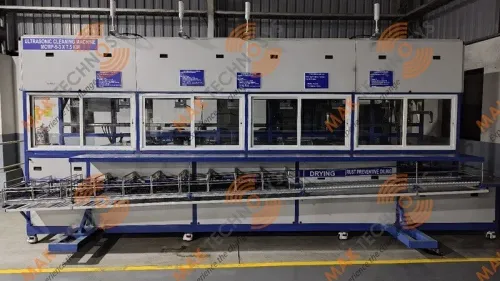
 | Conveyorized Bearing Cleaning Equipment Conveyorized Bearing Cleaning Equipment Conveyorised Bearing Cleaning Equipment Manufacturer in Pune In bearing manufacturing and refurbishment processes, cleanliness is critical to ensure... View product → |
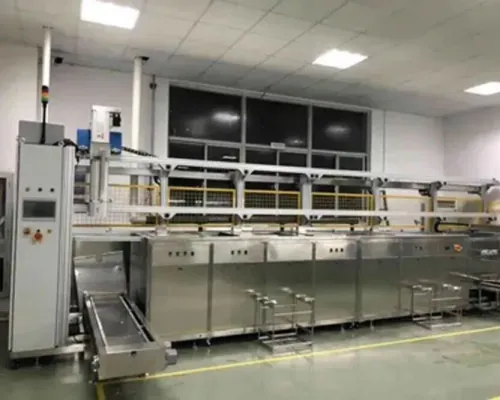
 | Ultrasonic Bearing Cleaning & Vapor Degreasing Equipment Ultrasonic Bearing Cleaning & Vapor Degreasing Equipment Advanced Cleaning Solutions for Precision Component Introducing our cutting-edge Ultrasonic Bearing Cleaning & Vapor Degreasing Machine, meticulously... View product → |
Control Pune-specific utilities, shutdown work and service handover
Measure utilities at the machine during a fault before replacing a pump or transducer. Record three-phase voltage, water pressure and flow, compressed-air pressure, and exhaust performance under operating load; Pune production lines can hide failures behind fluctuating supplies.
Treat hard-water scale as a process fault. Test the incoming water, then set descaling frequency from the result and material compatibility. Scale on heaters, manifolds, heat exchangers, or ultrasonic tank surfaces reduces heat transfer and restricts flow; aggressive acid can attack stainless steel, seals, heater sheaths, and transducers.
Before a monsoon shutdown, inspect vapor-degreasing bath temperature or boiling point, condenser cooling, freeboard containment, water separation, lid seals, solvent loss, and corrosion. Drain compressed-air receivers and filters, repair automatic drains, and confirm ventilation removes heat, mist, and solvent vapour without pulling vapour beyond the enclosure.
- Isolate and lock out electrical, pneumatic, hydraulic, thermal, and chemical energy before entering tanks, conveyors, or guarded zones. Verify zero energy; interlocks are not isolation.
- Stage critical spares: nozzles, seals, filters, heater parts, pump components, air drains, sensors, and fuses. Label each part with machine and revision.
- Containerise spent solvent, oily sludge, contaminated filters, and concentrated bath separately. Record waste stream, quantity, container, manifest or handover record, and authorised Maharashtra disposal route.
- Hand over signed readings, work completed, replaced parts, leaks found, and pending risks. Release the line only after confirming spray pressure and pattern, bath concentration and temperature, drying, exhaust, and a cleanliness test on production bearings.
Frequently asked questions
How do you build a maintenance schedule for conveyorized bearing cleaning equipment?
Set inspection intervals around process readings, including tank temperature, wash and rinse pressure, conveyor speed, detergent concentration, filter differential pressure and dryer performance. Record baseline values, assign owners and schedule corrective work before readings drift beyond the machine’s operating range.
What components should you inspect on a bearing cleaning machine?
Inspect more than the conveyor and pump. Check spray nozzles, wash and rinse tanks, filters, heaters, seals, valves, piping, sensors, blowers, air knives, dryer elements and sludge or oil-collection points. Look for blocked nozzles, leaks, abnormal noise, worn belts and damaged insulation.
How can process readings diagnose bearing washer maintenance problems?
Compare current readings with a clean-process baseline. Low spray pressure points to blocked nozzles, a loaded filter, pump wear or a leak. Slow heating indicates heater, sensor or electrical faults. Poor drying calls for checks on airflow, air-knife position, blower condition and conveyor speed.
What should you prepare before arranging bearing cleaning machine service in Pune?
Provide the machine model, serial number, fault history, recent process readings, photographs, utility specifications and a list of replaced parts. Confirm water quality, electrical supply, compressed-air pressure, access, shutdown duration and safety isolation requirements before the technician arrives.