Pune’s monsoon does not automatically require higher ultrasonic power, but it can change the temperature control, drying, air quality, corrosion protection and transfer design your process needs. By the end, you can compare dew point with part temperature, define a monsoon-safe operating procedure and specify drying and equipment controls that produce consistently dry, corrosion-free components.
Key takeaways
- Use dew point, not relative humidity alone, to assess condensation risk.
- Dry parts before cooling below the room’s dew point.
- Specify filtered air, controlled drying and compatible cleaning chemistry.
- Choose multi-process equipment when washing, rinsing and drying need enclosure control.
When does Pune humidity become a cleaning-equipment problem?
Pune humidity becomes a cleaning-equipment problem when a surface reaches the room’s dew point, not simply when relative humidity is high. At 25 °C and 80% RH, the dew point is approximately 21.3 °C; an exposed part, tank wall, pipe, fixture or electrical panel at 21.3 °C or below can collect condensation.
Measure room temperature and RH with a calibrated hygrometer, then calculate or display dew point. Before loading, check the component with a contact probe or infrared thermometer.
| Surface | Compare before operation | Risk at or below dew point |
|---|---|---|
| Incoming part | Part temperature versus room dew point | Condensation dilutes water-based chemistry |
| Tank, pipe or fixture | Surface temperature versus room dew point | Water enters transfers or collects on equipment |
| Panel or cleaned part | Enclosure or part temperature versus room dew point | Electrical condensation or flash corrosion |
For multi process ultrasonic equipment for humid conditions in Pune, specify the room dew point and minimum temperatures for incoming parts, tanks, piping, fixtures, electrical panels and cleaned parts. Warm the part or lower the surrounding dew point when the temperature difference is too small.
Humidity does not directly demand more ultrasonic generator power after the bath is established. Cavitation depends more on:
- Bath temperature and vapor pressure
- Viscosity and dissolved-gas content
- Bath level, transducer condition and frequency
These variables cause ultrasonic cleaning humidity problems through process control, drying and corrosion—not automatically through weaker cavitation. Log the dew point and surface temperatures during the monsoon acceptance test.
Which humidity problems occur before and after cavitation?
Cold components can condense before washing starts. That water enters the bath without a measured dose and dilutes water-based chemistry. During washing, liquid hides in blind holes, threads, overlaps, narrow bores and porous fixtures, extending drainage and drying time.
| Condition | Humidity problem | Process consequence |
|---|---|---|
| Incoming cold component | Surface condensation before cavitation | Uncontrolled bath water, diluted chemistry and possible soil redistribution |
| Part in wash or rinse | Liquid retained in holes, threads, overlaps, bores or porous fixtures | Longer drainage and residual-water risk |
| Fresh ferrous part | Water film on carbon steel, cast iron or low-alloy steel at high dew point | Flash rust after rinsing |
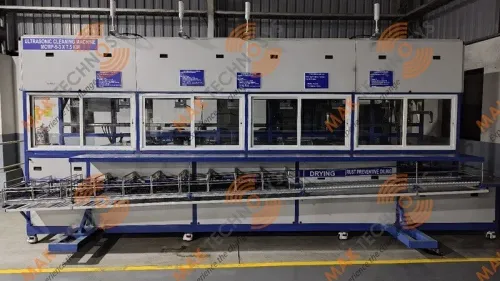
| Multi process ultrasonic machine | Open tank transfers, elevators, doors, rinse stations and drying-zone entrances | Clean parts can re-wet between stages |
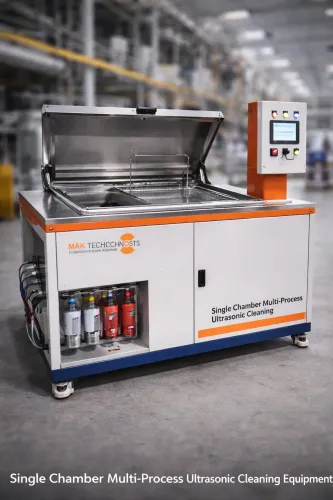
| Single chamber ultrasonic equipment in Pune | Fewer open transfers and less floor exposure | Lower exposure, but not zero humidity risk |
A single chamber still needs separate wash, rinse, drain and dry recipes. Check fixture orientation, chamber air exchange and trapped liquid; one chamber does not solve every ultrasonic cleaning humidity problem.
For vapor-degreasing, define how wet incoming parts, humid-air leaks and water in solvent sumps or separators will be controlled. In oil-skimming or oil-filtration systems, test free-water carry-in, emulsion formation, filter life and skimmer capacity with the actual coolant or oil.
What should a monsoon operating procedure include?
Run the procedure as a logged recipe for every industrial ultrasonic cleaning system cycle during monsoon conditions. These controls address ultrasonic cleaning humidity problems before condensation, trapped rinse water and flash rust become defects.
1. Record room temperature, relative humidity, dew point, bath temperature, bath concentration and compressed-air pressure dew point at the cycle start.
2. Measure each cold component’s surface temperature. Preheat it when that temperature is at or below the room dew point, and load it only after visible condensation has disappeared. Keep doors closed between transfers.
3. Use the specified wash temperature and drain time. Do not shorten draining to preserve throughput. Use a heated rinse when the process and material allow it, then orient fixtures with blind holes and bores facing downward.
4. Apply an air knife to exposed surfaces, followed by forced hot air through passages and overlaps. Use vacuum drying when capillary liquid remains after heated blow-off.
5. Unload only when the part meets the required dry standard, not merely when it feels warm. Protect ferrous parts with validated corrosion-inhibitor chemistry, a controlled final rinse or temporary packaging, and confirm compatibility with coating, bonding, welding and dimensional requirements.
6. Store finished parts in clean, dry, lidded containers or sealed packaging; never place them on a damp rack. During the longest monsoon cycle, record residual water, flash-rust observations and final-part temperature.
How should you specify drying, air and chemistry?
Specify drying by measurable outcomes, not “dry parts.” A trial for an industrial ultrasonic cleaning system must use the deepest blind hole, longest drain path, porous fixture and maximum load.
1. Record hot-air temperature, air volume, filtration level, exhaust arrangement, drying time and final-part temperature. Define residual-water acceptance, such as no visible droplets, a timed blotter test, mass change or a customer-approved cleanliness method. Air knives remove surface films but can leave capillary water in blind holes.
2. Use heated forced air to improve evaporation. Add vacuum drying when enclosed passages retain water; vacuum lowers the boiling point but adds capital cost, energy use or cycle time. A water-displacing final step can reduce residue, but validate it against later coating, bonding and cleaning.
3. Specify compressed air at the machine inlet by ISO 8573-1 class or pressure-dew-point value. Include a correctly sized dryer, automatic drains, moisture separator and point-of-use filter. Reject “dry air” as a requirement because it cannot be checked.
4. Check water-based chemistry with concentration measurements, bath-contamination checks and corrosion-inhibitor validation. Dose detergent from the chemical supplier’s technical data sheet and safety data sheet, not a calendar reminder or guess.
5. Fit panel heaters, anti-condensation thermostats, controlled ventilation or enclosure air conditioning where cycling threatens PLCs, VFDs, ultrasonic generators or terminals. An IP rating does not stop internal condensation.
These controls define multi process ultrasonic equipment for humid conditions in Pune by evidence rather than assumption. Test final-part dryness and inhibitor compatibility before approving the recipe.
Which equipment choice is justified for your monsoon process?
Choose facility dehumidification when condensation control must cover the entire cell; choose machine-side control when only the part, rinse-to-dry path, or final coating condition needs protection.
| Option | What it controls | Cost or limitation |
|---|---|---|
| Facility HVAC or dehumidification | Room air, tanks, fixtures, panels and exposed parts | Higher facility energy, maintenance and capital cost |
| Machine-side drying | Heated air, filtered low-dew-point air, vacuum and controlled transfers | Higher machine cost, utility use and cycle time |
| Combined control | Cell condensation plus difficult geometries and final drying | Justified for dry-to-touch, corrosion-free or coating-ready parts |
A multi-chamber system needs sealed or controlled transfers, dedicated drying capacity and protection at every rinse-to-dry interface. A single chamber reduces open transfers and floor exposure, but its chamber air exchange, recipe steps and fixture drainage must handle the worst-case geometry. Single chamber ultrasonic equipment in Pune is not automatically monsoon-proof.
Ask Mak Technosys to evaluate multi-process ultrasonic equipment for humid conditions in Pune against your actual process, not ultrasonic power alone. Bring:
- Representative parts, including the deepest blind hole and longest drain path
- Maximum fixture load and actual oil or coolant soil
- Required downstream coating condition
- A realistic humid ambient condition
Require logged room dew point, bath temperature and concentration, compressed-air pressure dew point, dryer outlet temperature, final-part temperature, residual-water results and corrosion results. Approve the industrial ultrasonic cleaning system only after it passes this acceptance test with no trapped water or unacceptable flash rust.
Related products
 | Ultrasonic Cleaning Equipment Multi Chamber Multi-Process Ultrasonic Cleaning Equipment Multi Chamber Multi-Process Ultrasonic Cleaning Equipment in Pune. View product → |
 | Ultrasonic Cleaning Equipment Single Chamber Multi-Process Ultrasonic Cleaning Equipment Single Chamber Multi-Process Ultrasonic Cleaning Equipment in Pune In today’s precision-driven manufacturing environment, maintaining component... View product → |
Frequently asked questions
When does Pune humidity become a cleaning-equipment problem?
Humidity becomes a condensation risk when a part, tank wall, pipe, fixture or electrical panel reaches the room’s dew point. At 25 °C and 80% RH, the dew point is approximately 21.3 °C.
Which humidity problems occur before and after cavitation?
Before cavitation, condensation can dilute chemistry, wet electrical components and introduce uncontrolled water onto parts. After cavitation, trapped rinse water and humid air can slow drying, leave watermarks and promote flash corrosion on susceptible metals.
What should a monsoon operating procedure include?
Record room temperature and relative humidity, calculate or check dew point, keep parts covered before cleaning, inspect tank and panel surfaces for condensation, control transfer time, and verify dryness before packing.
How should you specify drying, air and chemistry?
Specify drying temperature and time, air temperature and filtration, air pressure or flow, drainage, and chemistry concentration and operating temperature. Confirm compatibility with the metals, seals and soils being cleaned.
Which equipment choice is justified for your monsoon process?
Choose a multi-process ultrasonic machine when washing, rinsing, drying and transfer must be controlled in sequence. A single-chamber ultrasonic equipment setup in Pune can suit simpler loads when separate process stages still protect parts from humid-air exposure.