
Bearing grease, metal fines, seal debris, and oil can move from one dirty bearing into the tank, pumps, filters, rinse stages, and drying area. By following a controlled isolation, cleaning, inspection, and test-load process, you can identify the contamination route, choose the right recovery level, and release the equipment without redepositing particles or damaging bearings.
Key takeaways
- Stop loading parts and quarantine every contacted tank, hose, pump, and drying stage.
- Drain and flush when metal fines or heavy bearing grease have entered circulation.
- Control solvent vapour, ignition sources, and waste during vapor-degreasing machine recovery.
- Release the system only after a representative test load passes documented cleanliness checks.
Isolate the contaminated equipment before debris spreads
Stop loading production parts as soon as bearing cleaning equipment contamination is detected. Quarantine the tank, baskets, filters, rinse stages, pumps, hoses, conveyors, and drying area that contacted the bath; continued circulation can carry oil and metal fines into clean stages.
- Stop ultrasonic power, heaters, circulation pumps, conveyors, spray pumps, and compressed air. Prevent unexpected starts.
- Apply the site lockout/tagout procedure to electrical and pneumatic energy. Let the bath and heated parts cool before opening or handling the equipment.
- Drain or transfer the fluid into compatible, labelled containers placed in secondary containment. Do not discharge contaminated cleaner.
- Record the time, affected load, bath condition, machine status, and suspected source while the event is still traceable.
- Trace the contamination route before cleaning. Check for a failed bearing seal, overloaded basket, incorrect loading, oil carryover, leaking rinse stage, damaged filter, or blocked overflow.
- Do not restart circulation or add fresh detergent to dilute the contamination. Both actions can move fines and oil into pumps, hoses, rinse stages, and drying equipment.
An assembled, sealed, shielded, or grease-filled bearing is not automatically recoverable through ultrasonic cleaning. Cavitation and liquid penetration can displace grease, damage seals, or carry abrasive particles into the raceway. For a critical bearing, obtain the manufacturer’s cleaning, disassembly, relubrication, and inspection instructions, or replace it rather than risk hidden damage.
Choose between skimming, filtration, draining, flushing, and dismantling
The amount of a water-based ultrasonic system you recover depends on where contamination has travelled, not simply on how dirty the tank looks.
Identify the contaminant first: free oil, suspended metal fines, seal fragments, rust, alkaline detergent residue, or solvent residue. Check oil loading, cleaner concentration, conductivity, odour, and visible solids against the process limits.
| Option | What it means | When it applies |
|---|---|---|
| Skim and filter | Remove floating oil, then capture suspended solids | The source is removed, chemistry remains within specification, and no sludge entered pumps or dead legs |
| Drain and recharge | Remove all bath chemistry and prepare a fresh charge | Oil loading, concentration, conductivity, odour, or visible solids exceed the process limit |
| Flush | Clean connected passages without necessarily replacing every component | Contamination could return through circulation lines, pump housings, spray manifolds, overflow weirs, or rinse plumbing |
| Dismantle | Open and clean the affected circuit | A filter failed, a pump seized, sludge sits behind valves, or contamination reached heaters, probes, transducer faces, or inaccessible piping |
Remove floating oil with a skimmer or oil separator before filtration. A cartridge filter captures suspended solids; it does not reliably remove dissolved or emulsified oil.
Before charging new chemistry, clean the tank bottom, weld corners, level probes, heater surfaces, transducer faces, skimmer, hoses, pump housing, and dead legs. Trapped sludge or oil can recontaminate the next cycle.
Use chemistry compatible with the equipment. An oil remover can leave corrosive alkaline residue; an aggressive solvent can damage elastomers, plastics, paint, or aluminium.
Send spent cleaner, oil-water mixtures, sludge, and contaminated filters through the site’s approved hazardous-waste route in India. Never discharge them to a drain because the bath is water-based.
Recover a vapor-degreasing machine without creating a solvent hazard
Solvent vapour changes recovery from bath cleaning into a flammable-exposure and emissions-control task. Follow the solvent’s safety data sheet, plant permit, and waste procedure before opening, draining, or cleaning the machine.
1. Confirm the solvent’s flash point, boiling range, vapour exposure limits, grounding and bonding requirements, ventilation rate, compatible containers, and ignition controls. Apply lockout/tagout, isolate heat and electrical energy, and prevent unauthorised access. Never introduce water, detergent, or an incompatible cleaner into the solvent circuit.
2. Drain and contain contaminated solvent from every connected zone, not only the main sump. Inspect the boiling sump, rinse sump, still or solvent-recovery circuit, water separator, condenser, freeboard zone, filters, vapour-level controls, piping, and low points.
Remove sludge and still bottoms as identified waste, then label spent solvent and contaminated filters with their composition and hazard information.
3. Do not improvise a solvent blend or substitute another solvent. Check tank materials, elastomer compatibility, emissions requirements, boiling behaviour, and the supplier’s safety data sheet before using any replacement.
4. Before restart, check covers, gaskets, seals, solvent leaks, condenser performance, ventilation, freeboard-zone operation, and solvent concentration. Vapor degreasing machine recovery requires a qualified service technician after a leak, unknown solvent mixture, failed condenser, or vapour-control fault; operators should not open or clean those conditions without specialist assessment.
Inspect the machine and prove cavitation, rinsing, and drying performance
Before release, inspect every surface and flow path that could retain or return bearing debris. Check transducer faces for sludge, impact damage, and deposits; tank welds and corners for trapped debris; heater surfaces for oil film; and level sensors and probes for fouling.
- Inspect pump housings, impellers, seals, valves, hoses, and spray nozzles for blockage or leakage. Check baskets and conveyors for transferred particles.
- Confirm oil-skimmer operation, filter differential pressure, circulation flow rate, rinse overflow, and rinse-water quality.
- Verify drying-air filtration, oil content, dew point, pressure, and cleanliness. Do not use unfiltered shop air: it can add oil, water, and particles or drive contamination into bearing raceways.
- Charge fresh water-based chemistry at the specified concentration and temperature, then run the machine’s stated degas cycle. Dissolved air absorbs acoustic energy, and tank volume, chemistry, temperature, and water quality make one fixed degassing time unreliable.
| Check | Method | Failure consequence |
|---|---|---|
| Cavitation | Foil test or equivalent, with ASTM G131 as a reference | Inactive transducers leave contamination behind |
| Rinsing | Measure overflow, water quality, and carryover | Cleaner, chlorides, or rinse solids cause corrosion |
| Drying | Confirm filtered air and dry promptly | Residual moisture promotes corrosion |
| Cleanliness | Gravimetric residue, particle extraction and microscopy, or approved method | Visual inspection alone misses harmful contamination |
If you use ISO 4406, document the extraction method and sample location; it reports particles in hydraulic-fluid samples, not complete bearing cleanliness. Record these results in your ultrasonic bearing cleaner maintenance trend.
Release the system only after a representative test load and documented trend
A clean empty basket proves nothing. Run a witnessed test load containing representative bearings and the hardest-to-clean grease, oil, fines, or seal debris, then complete the specified cleanliness, residue, particle, drying, rinse, and functional checks.
Release the system only when results meet the plant’s defined acceptance limit. Record:
- Contamination source, isolation time, drained volume, approved waste route, and parts cleaned
- Chemistry batch, inspection findings, corrective actions, and approving signatures
Use the recovery results to separate process exhaustion from equipment failure:
| Cause indicated by trend | Evidence to review | Corrective focus |
|---|---|---|
| Bath exhaustion | Rising residue, conductivity, or failed cleanliness results with normal flow | Recharge chemistry and reset bath-life control |
| Blocked filter | Increasing differential pressure and falling flow | Replace or clean the filter and inspect trapped sludge |
| Circulation fault | Low pump flow, uneven cleaning, or redeposition | Inspect pump, valves, hoses, and dead legs |
| Heater or level fault | Temperature or level outside setpoint | Check heater, probe, and low-level protection |
| Inactive transducer | Failed cavitation test despite correct chemistry and flow | Inspect transducer faces, wiring, and generator |
Start a maintenance trend for bath age, concentration, temperature, conductivity, filter differential pressure, skimmer performance, ultrasonic hours, pump flow, rinse quality, and cleaning-test results. For manufacturers seeking to recover ultrasonic cleaning equipment after bearing for contamination in coimbatore, Mak Technosys can help review recurring filtration, oil-separation, or process-control failures without replacing equipment unnecessarily.
Related products
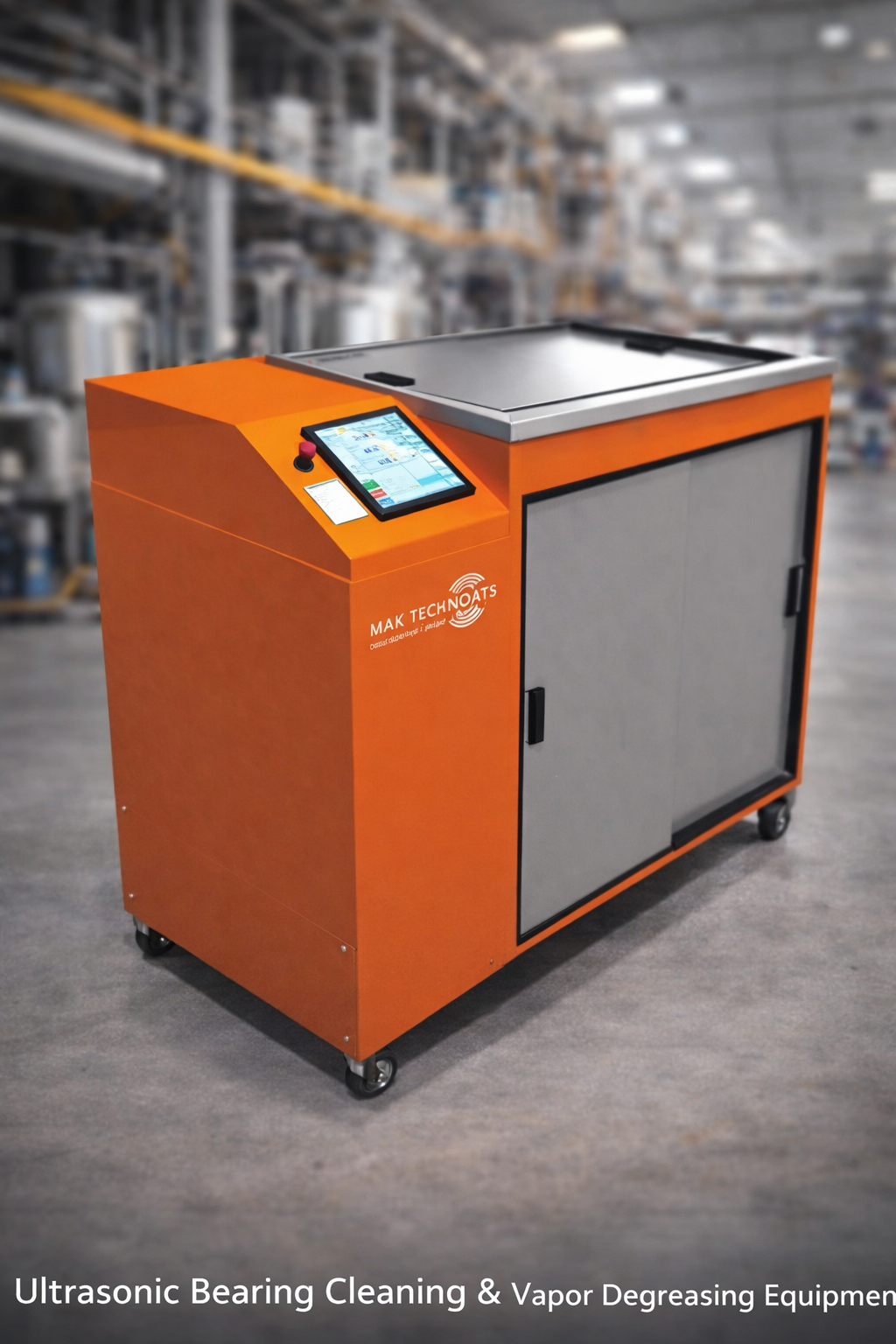 | Ultrasonic Bearing Cleaning & Vapor Degreasing Equipment Ultrasonic Bearing Cleaning & Vapor Degreasing Equipment Advanced Cleaning Solutions for Precision Component Introducing our cutting-edge Ultrasonic Bearing Cleaning & Vapor Degreasing Machine, meticulously... View product → |
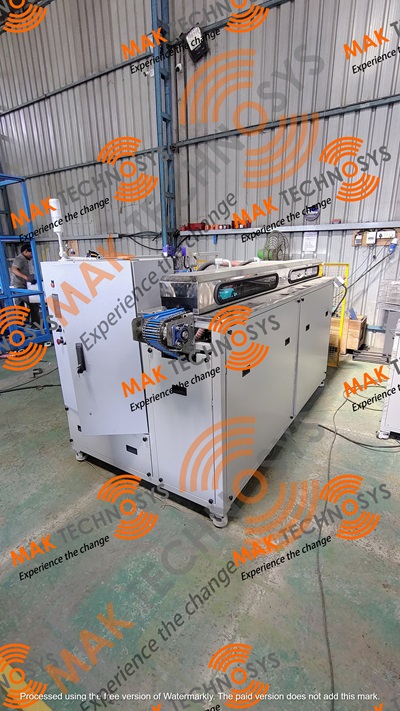 | Conveyorized Bearing Cleaning Equipment Conveyorized Bearing Cleaning Equipment Conveyorised Bearing Cleaning Equipment Manufacturer in Pune In bearing manufacturing and refurbishment processes, cleanliness is critical to ensure... View product → |
Frequently asked questions
What equipment must you isolate after bearing contamination?
Quarantine the tank, baskets, filters, rinse stages, pumps, hoses, conveyors, and drying area that contacted the contaminated bath. Stop circulation and prevent contaminated parts from entering clean stages.
Should you skim, filter, drain, flush, or dismantle contaminated cleaning equipment?
Skim floating oil when the bath remains otherwise clean. Filter suspended oil and fines when the system supports safe filtration. Drain and flush heavy contamination, and dismantle pumps, hoses, filters, and dead legs when debris can remain trapped.
How do you recover a vapor-degreasing machine safely?
Stop heating and isolate the solvent circuit, control ignition sources, ventilate the area, use the solvent's safety data sheet for handling limits, and collect contaminated solvent as hazardous waste. Do not open hot equipment or create vapour clouds during draining.
When can recovered equipment return to production?
Inspect the machine, prove cavitation, rinsing, and drying performance, then process a representative test load. Release the system only when cleanliness results and operating trends meet the documented acceptance limits.
Related product
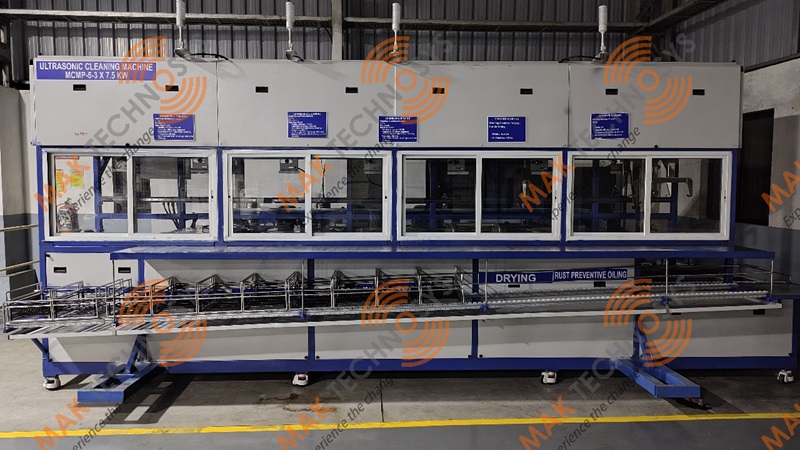 | Solvent Based Automatic Ultrasonic Cleaning Equipment Solvent Based Automatic Ultrasonic Cleaning Equipment Solvent Based Automatic Ultrasonic Cleaning Equipment in Pune Solvent Based Automatic Ultrasonic Cleaning Equipment is designed for high-precision... View product → |