
A seven-tank line is not a standard process: one supplier may count a dryer or treatment station, while another counts only liquid tanks. You will be able to define the required sequence, calculate usable capacity, compare cleaning methods and machine options, and request quotations that can be tested against your parts and acceptance limits.
Key takeaways
- Treat each tank as a defined process station, not a standard cleaning recipe.
- Match chemistry, temperature, agitation, and drying to the part and soil.
- Calculate hourly throughput from load size, cycle time, and equipment uptime.
- Compare quotations using identical tanks, utilities, automation, filtration, and testing.
Define What the Seven Stations Actually Do
A seven-tank quotation means seven counted process stations, not a standardized sequence with a fixed industry definition. An industrial seven tank washer can therefore differ substantially from another machine carrying the same label.
For oily steel components, a credible aqueous sequence is:
- Pre-wash or alkaline wash to remove bulk oil and soil.
- Ultrasonic cleaning to work into recesses and small features.
- Intermediate rinse to reduce cleaner carryover.
- Second rinse to remove remaining alkaline solution.
- Final deionized-water rinse for low ionic residue.
- Corrosion-inhibitor or passivation treatment.
- Hot-air drying.
Another layout may count loading, oil skimming, filtration, or the dryer as a station. A supplier might also combine pre-wash and ultrasonic cleaning, so tank count alone does not prove cleaning performance.
Request a station-by-station process-flow diagram showing working dimensions, usable volume, transfer path, dwell time, heating, rinsing, filtration, oil separation, and drying. Ask where pumps, filters, skimmers, heaters, and drains sit.
Specify cascade or counter-current rinsing when water use and carryover matter: clean water enters the final rinse, then overflows toward progressively dirtier upstream rinses. Select the sequence from the component material, soil, geometry, and allowable residual chemistry—not from a catalogue label or a competitor’s tank count.
Match the Cleaning Sequence to Parts, Soil, and Surface Limits
Seven tanks are appropriate only when the component needs distinct cleaning, rinsing, treatment, and drying stages that one or two processes cannot deliver.
1. Document the part before choosing the layout. Record the substrate—aluminium, copper, brass, steel, plated metal, rubber, or coated material—along with oil, coolant, chips, salts, carbon, or polishing compound.
Note blind holes, internal passages, mating surfaces, nesting, surface finish, coating adhesion, elastomer limits, allowable ionic or chemical residue, basket size, load density, and required parts per hour.
2. Match the method to the contamination. Immersion provides complete wetting and suits irregular parts. Spray cleaning suits exposed surfaces and high flow. Ultrasonic energy reaches complex features, but nested parts and deep cavities create acoustic shadowing.
Vapor degreasing targets compatible solvent-soluble oils; it does not replace aqueous cleaning when you need particulate removal, rinsing, passivation, or controlled ionic residue.
3. Treat ultrasonic frequency as one design input. Systems operating at 20–40 kHz are common for aggressive general cleaning; higher frequencies suit finer features and gentler cavitation. Frequency alone proves nothing without delivered acoustic power, transducer placement, bath temperature, chemistry, and load density.
4. Run a production trial before approving a combined seven-tank aqueous process. Use production baskets, actual contamination, maximum load density, internal passages, mating surfaces, and blind holes. Inspect hidden areas after cleaning.
Set separate chemistry, temperature, and exposure limits for aluminium, copper, brass, steel, plated parts, rubber, and coatings; an unsuitable bath can etch metal, lift plating, swell elastomers, or attack a coating.
Compare 7 Tank Cleaning Machine Options Beyond Tank Count
| Manual transfer | Operator moves each basket | Lower capital cost; higher handling effort and positioning variation |
|---|---|---|
| Powered hoist transfer | Motorised lift moves baskets between stations | Repeatable dwell, less lifting, higher controls and maintenance |
| Fixed sequence | One programmed route | Stable single product; limited changeover flexibility |
| Recipe PLC and HMI | Stored recipes control dwell, temperature, transfers, alarms | Multiple parts, traceability, controlled changeovers |
| Single-basket handling | One basket per transfer cycle | Simple loading; lower output |
| Multiple-basket handling | Several baskets move together or independently | Higher output; greater mass, clearance, and control demands |
| Ambient tanks | No process heating | Rinses or chemistry that works at room temperature |
| Heated wash and rinse tanks | Controlled thermal process | Faster soil removal, evaporation, and drying; higher energy use |
| Air-knife blow-off | Compressed air displaces surface water | Open surfaces and short cycles |
| Heated air, vacuum, or combined drying | Heat evaporates water; vacuum removes trapped moisture | Blind holes, overlaps, and strict residual-moisture limits |
Ask for basket length, width, height, usable payload, maximum load mass, transfer stroke, clearance, loading orientation, and drain time. Confirm whether the dryer meets residual-water limits at maximum load.
Separate bath functions: a belt, disc, or tube skimmer removes floating separable oil; filtration removes suspended particles. Neither reliably removes dissolved or chemically emulsified oil.
Specify tank, heater, pump, piping, seal, basket, and transducer materials separately. Put concentration, pH, temperature, conductivity or resistivity, hardness, chlorides, silica, drag-out, bath replacement, wastewater, exhaust, and chemical data-sheet requirements in writing.
Adding tanks can improve rinse separation, but increases footprint, heat-up energy, chemical volume, maintenance, and wastewater. A two-stage wash with cascade rinsing may outperform a larger line.
Calculate Capacity from the Production Rate You Need
A machine meets your output target only when its complete basket cycle fits the production window. Calculate required baskets per hour as required parts per hour divided by parts per basket, then calculate required cycle time per basket as available production time divided by required baskets.
Use the actual batch mass and loading density: parts per basket must reflect nesting, spacing, orientation, and the basket’s usable payload, not an empty-basket rating. Include loading, transfer, immersion or ultrasonic dwell, draining, rinsing, and drying in the cycle. A long drying stage can make the dryer, not the tanks, the bottleneck.
Ask the supplier to state these values at maximum production load:
- Parts per hour and baskets per hour
- Wash and rinse dwell times, transfer time, drain time, and heat-up time
- Heater power, pump flow, filtration rate, and ultrasonic delivered power
- Drying temperature and the stated time required to reach it
- Basket dimensions, usable payload, and maximum batch mass
Do not accept “dry” as the test result. Define allowable residual water in blind holes, beneath overlapping parts, and on finished surfaces, then require a trial using the largest production load.
Inspect internal passages and mating surfaces for trapped water and cleaning failure. Set measurable limits for particle residue, nonvolatile residue, ionic contamination, or another agreed cleanliness measure. ISO 16232 provides cleanliness-verification methods for road-vehicle components, but you and the customer must agree the extraction method and limit values before acceptance.
Normalize the Quotation Before Comparing Suppliers or Price
A multi tank cleaning machine price is comparable only when every supplier quotes the same process scope, payload, utilities, and acceptance test. Ask each seven tank process equipment supplier to mark every item as included, optional, or excluded; otherwise a low base price can hide the equipment needed to run production.
| Option | Compare on identical terms | Cost commonly hidden |
|---|---|---|
| Base process | Process-flow diagram, tank working dimensions and volume, usable payload, baskets, chemical compatibility, bath-control limits | Extra rinse, larger baskets, chemistry trial |
| Cleaning and drying | Ultrasonic frequency and delivered power, heating capacity, pump flow, filtration rate, oil-skimming capacity, dryer design and residual-moisture limit | Transducers, heaters, skimmer, air knife, heated air, vacuum |
| Plant scope | Rinse-water quality, DI or RO system, enclosure, exhaust, PLC/HMI, interlocks, utilities, wastewater equipment | Water treatment, ventilation, controls, freight, taxes |
Attach this checklist to every request for quotation:
- Chemical data sheets, concentration, pH, temperature, conductivity or resistivity limits, bath replacement method, and maintenance intervals.
- Transfer method, baskets, usable payload, pump and filtration data, oil-removal performance, and heating loads.
- Enclosure, exhaust, DI or RO scope, wastewater equipment, PLC/HMI, alarms, interlocks, installation, commissioning, spares, freight, taxes, and site-installation responsibilities in writing.
- A written process-trial report using production parts and maximum load, with cycle time and acceptance criteria.
For searches such as seven tank process cleaning machines in Coimbatore, compare local quotations on this identical scope. Mak Technosys belongs in that comparison when its team supplies the dimensions, utility loads, process evidence, and acceptance criteria—not merely a tank count.
Related product
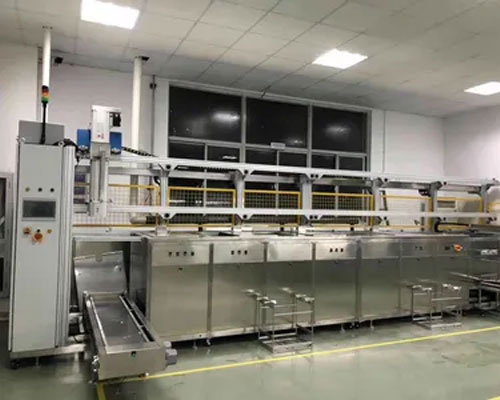 | 7 Tank Cleaning Machine Mak Technosys operates as a leading Tank Cleaning Machine Manufacturers, Suppliers, and Exporters in Pune. View product → |
Frequently asked questions
What does a seven-tank process cleaning machine include?
It includes seven counted process stations, but the sequence is not standardized. Confirm whether each station is washing, rinsing, passivation, drying, inspection, or another defined operation.
How do you choose the cleaning sequence for a seven-tank washer?
Start with the soil, part material, geometry, cleanliness target, and surface limits. Then specify the chemistry, temperature, agitation, rinsing, drying, and filtration required at each station.
How do you calculate the capacity of a seven-tank cleaning machine?
Use the required parts per hour, parts per load, cycle time, loading and unloading time, and planned equipment uptime. Size the machine for the production rate rather than tank count alone.
What should you compare in seven-tank cleaning machine quotations?
Normalize tank dimensions, usable load size, process times, heating power, pump flow, filtration, oil separation, drying, controls, utilities, safety systems, installation, testing, and warranty terms.